Understanding the relationship between scope click value, and adjustment range is essential for accurate rifle scope adjustment. When zeroing at the range or dialing for long‑range shooting, turret clicks allow shooters to correct for bullet drop and windage, determining how precisely adjustments translate into point‑of‑impact changes.
This guide explains the principles behind rifle scope adjustment explained, including how MOA vs MIL scope systems work and how shooters calculate the correct number of clicks.
1. What Is Scope Click Value?
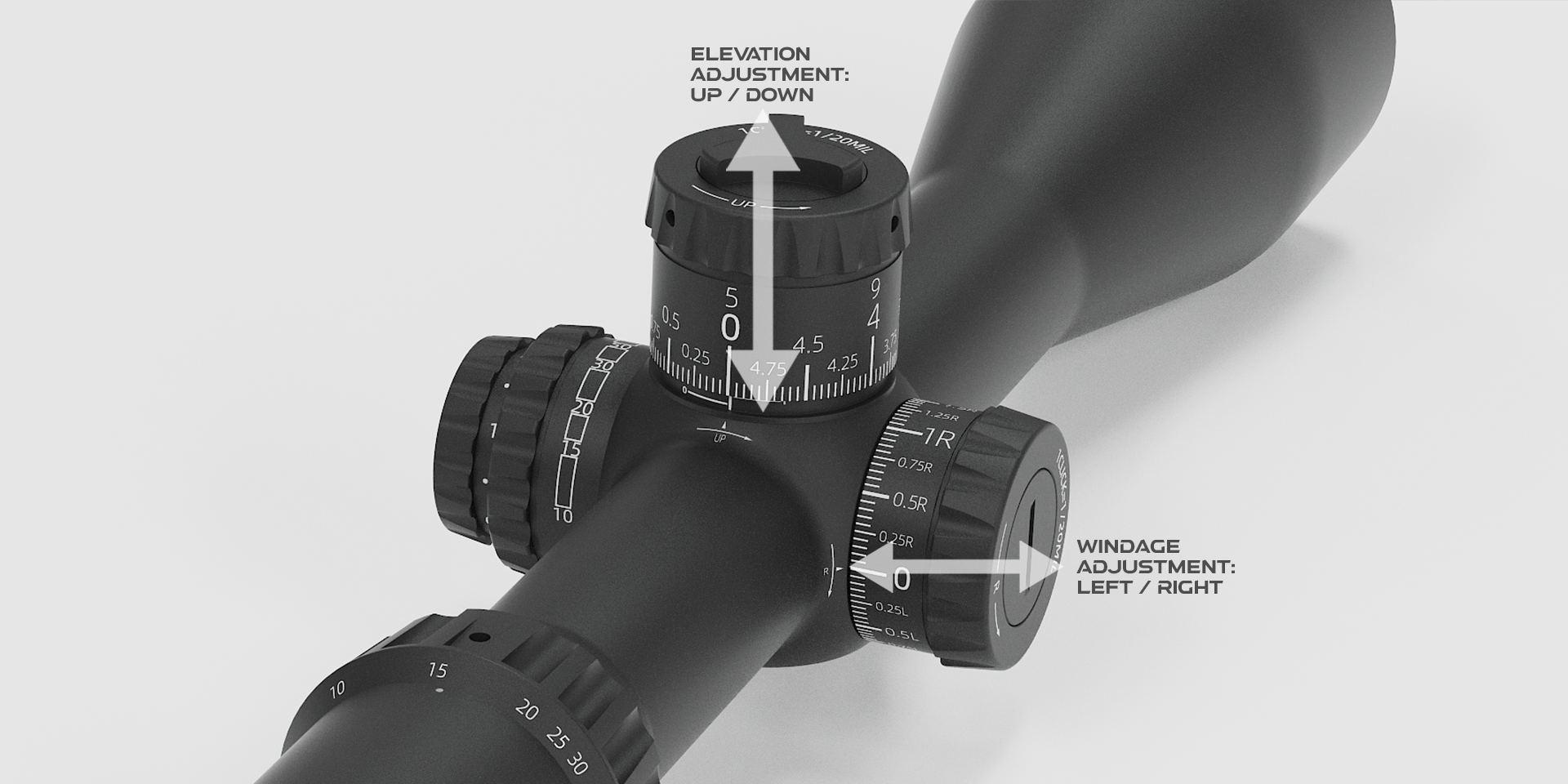
Scope click value refers to the angular amount the point of impact moves with each turret click. When shooters rotate the elevation turret or windage turret, each click adjusts the scope by a small angular increment.
The click value of a rifle scope determines how much each turret adjustment changes the point of impact, making it an important factor when learning how to adjust a rifle scope for different distances.
Most rifle scopes use either the MOA system or the MIL system. Understanding these systems is critical when learning how many clicks to adjust a rifle scope.
1.1 MOA Scope Adjustments
MOA (Minute of Angle) is a unit of angular measurement and the most common system used in American hunting and traditional shooting.
In geometry:
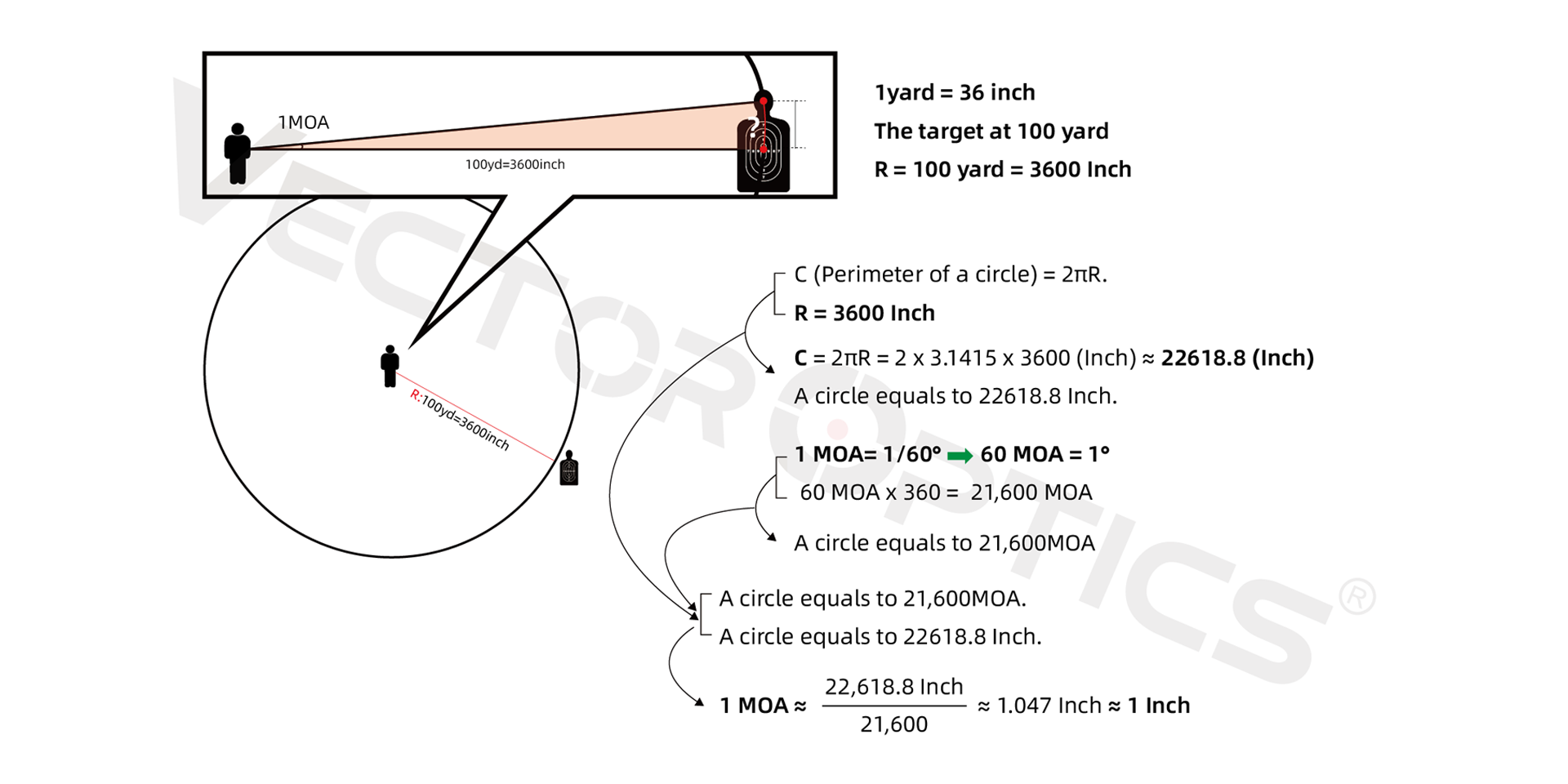
1 degree = 60 minutes
1 MOA = 1/60 degree
Because the angle is very small, MOA is well-suited for describing minute deviations and adjustments in long-range shooting.
In actual shooting:
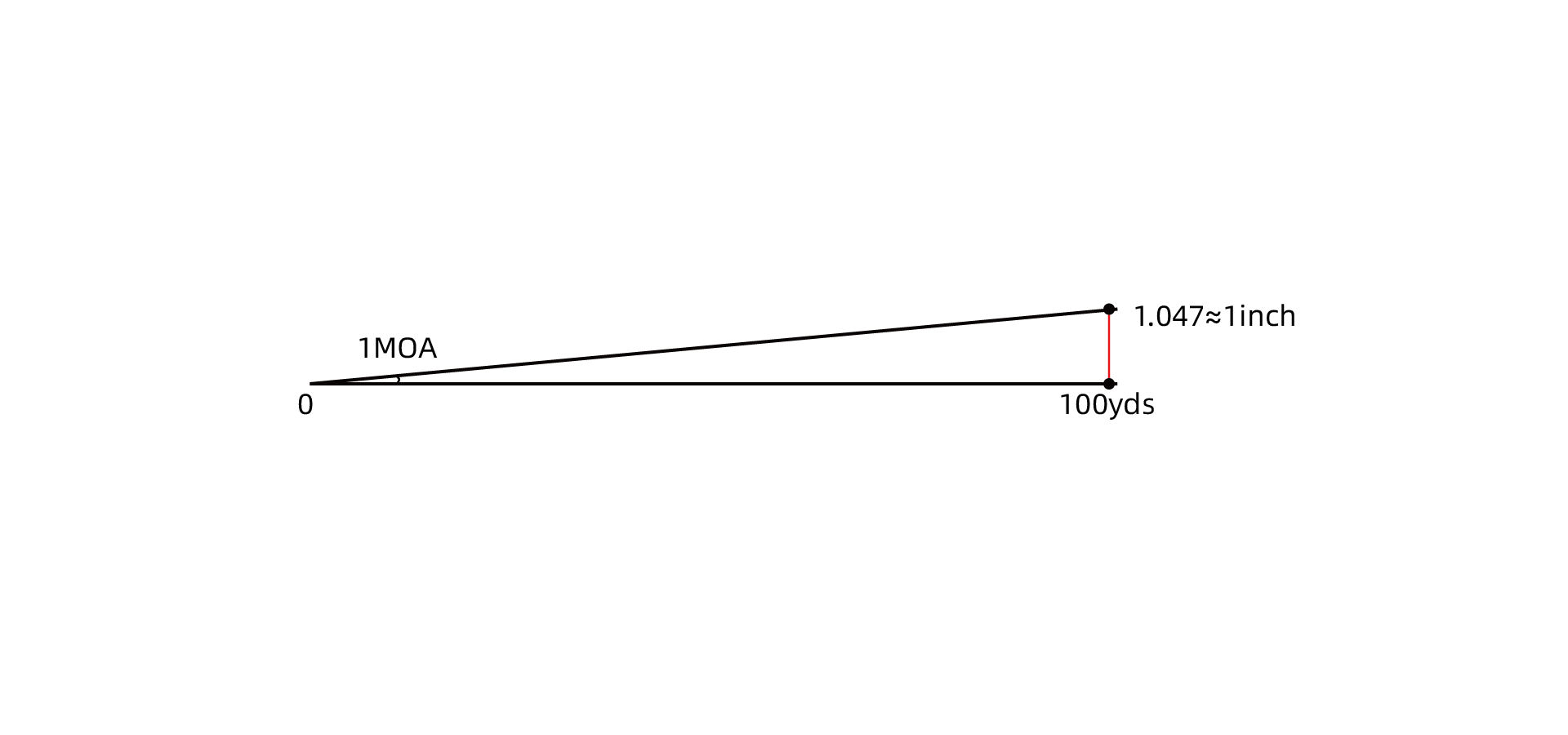
At a distance of 100 yards, 1 MOA ≈ 1.047 inches. For more detailed information about MOA, please click here.
For quick calculations in the field,shooters often approximate:
1 MOA ≈ 1 inch at 100 yards
For example, a scope with 1/4 MOA per click moves the point of impact by approximately 0.26 inches at 100 yards with each turret click.
Many rifle scopes use the MOA (Minute of Angle) system for turret adjustments, with common click values including 1/8 MOA, 1/4 MOA, 1/2 MOA, etc.
Among these, 1/4 MOA is the most widely used standard, as it offers a practical balance between adjustment precision and dialing speed, reducing the likelihood of over-adjustment during rapid target transitions.
A smaller MOA click value allows finer adjustments, while a larger click value provides faster dialing. Choosing the right click value depends on the shooting distance and accuracy requirements.
Because MOA represents an angle, the actual movement increases with distance. This principle is important when dialing rifle scope elevation adjustment for longer shots.
When learning how to adjust a rifle scope for different distances, shooters should consider that the same MOA adjustment will create different point-of-impact changes at different ranges.
1.2 MIL Scope Adjustments
MIL (Milliradian), also referred to as MRAD, is an angular measurement used in many modern rifle scopes. It is widely used in tactical and long‑range shooting because it allows shooters to calculate ballistic corrections efficiently at different distances.
Compared with MOA, the MIL scope adjustment system is often preferred by long-range shooters because it allows quick distance-based calculations and simple turret corrections.
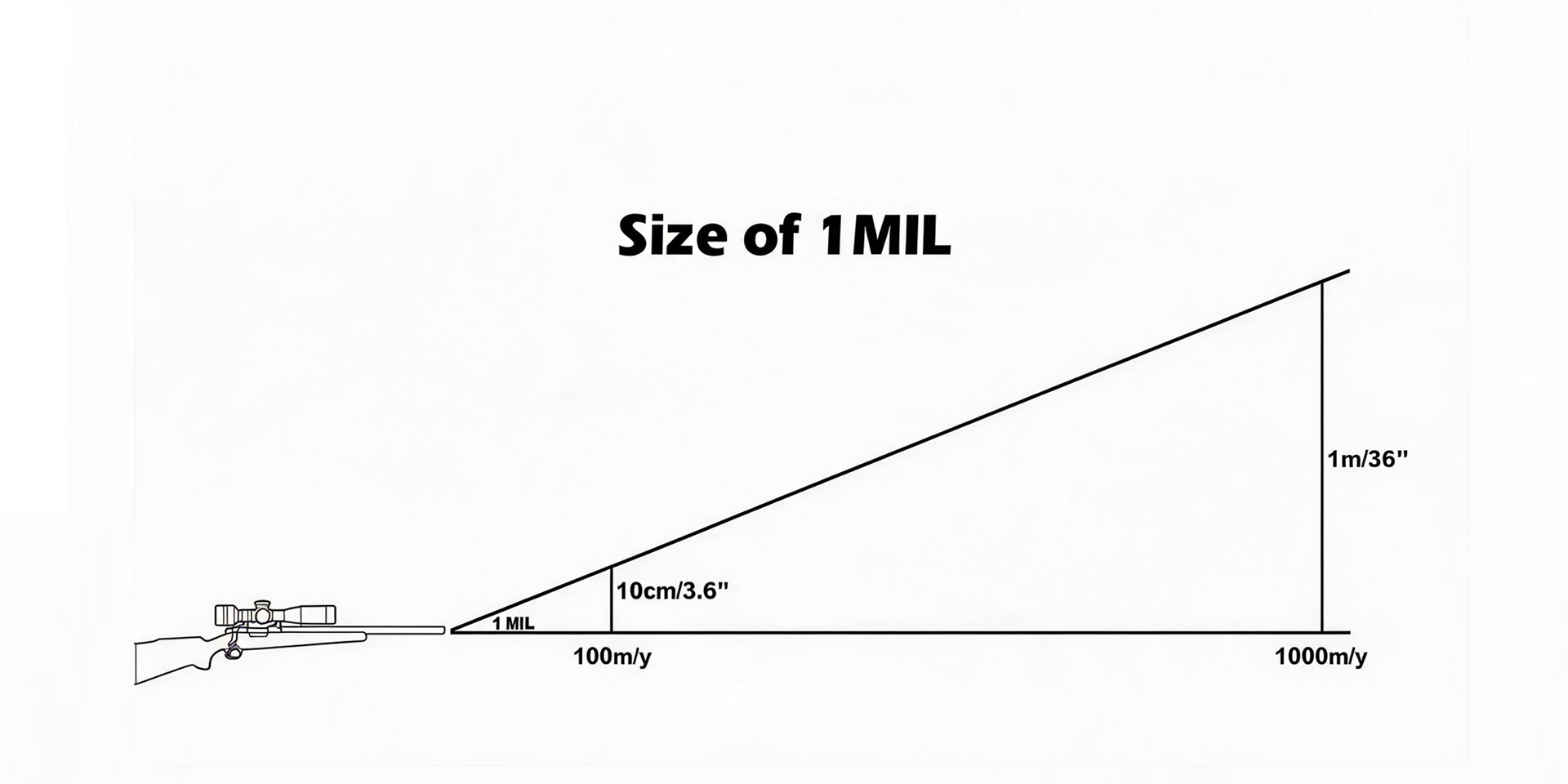
At 100 meters, 1 MIL ≈ 10 centimeters
At 100 yards, 1 MIL ≈ 3.6 inches
This means that if the scope's turret is adjusted by 1 MIL, the point of impact will move:
100 meters: approximately 10 cm
200 meters: approximately 20 cm
500 meters: approximately 50 cm
This property allows shooters to quickly estimate and apply ballistic corrections during long‑range shooting.
Most MIL scopes adjust in 1/10 MIL clicks, meaning each click moves the impact point:
1 cm at 100 meters
A 1/10 MIL adjustment is one of the most common click values used in modern MIL rifle scopes, providing a practical balance between precision and fast dialing.
Many modern rifle scopes also use the MIL system for turret adjustments, with common click values including 1/5 MIL, 1/8 MIL, 1/10 MIL, etc. Among these, 1/10 MIL adjustment is the most commonly used standard, offering a balanced combination of adjustment precision and efficient dialing for tactical and long‑range shooting.
Many shooters prefer the MIL system because it simplifies long-range scope adjustments and ballistic calculations. For more detailed information on using MIL adjustments, please refer to MIL or MOA? How to Use Them.
1.3 Smaller Click Values for More Precise Adjustments
In rifle scope adjustment systems, click value determines how much the point of impact shifts with each turret click. Because turret adjustments occur in fixed angular increments, the size of each increment directly affects adjustment precision.
Smaller click values produce smaller impact shifts, allowing shooters to make finer corrections—an important advantage in long-range shooting where small adjustments can significantly influence accuracy.
The relationship between click value and adjustment precision can be illustrated by comparing common MOA and MIL turret increments. Because both systems measure angles, they can be converted: 1 MOA ≈ 0.29 MIL, and 1 MIL ≈ 3.44 MOA.
The table below lists common click values from the smallest (most precise) to the largest (least precise).
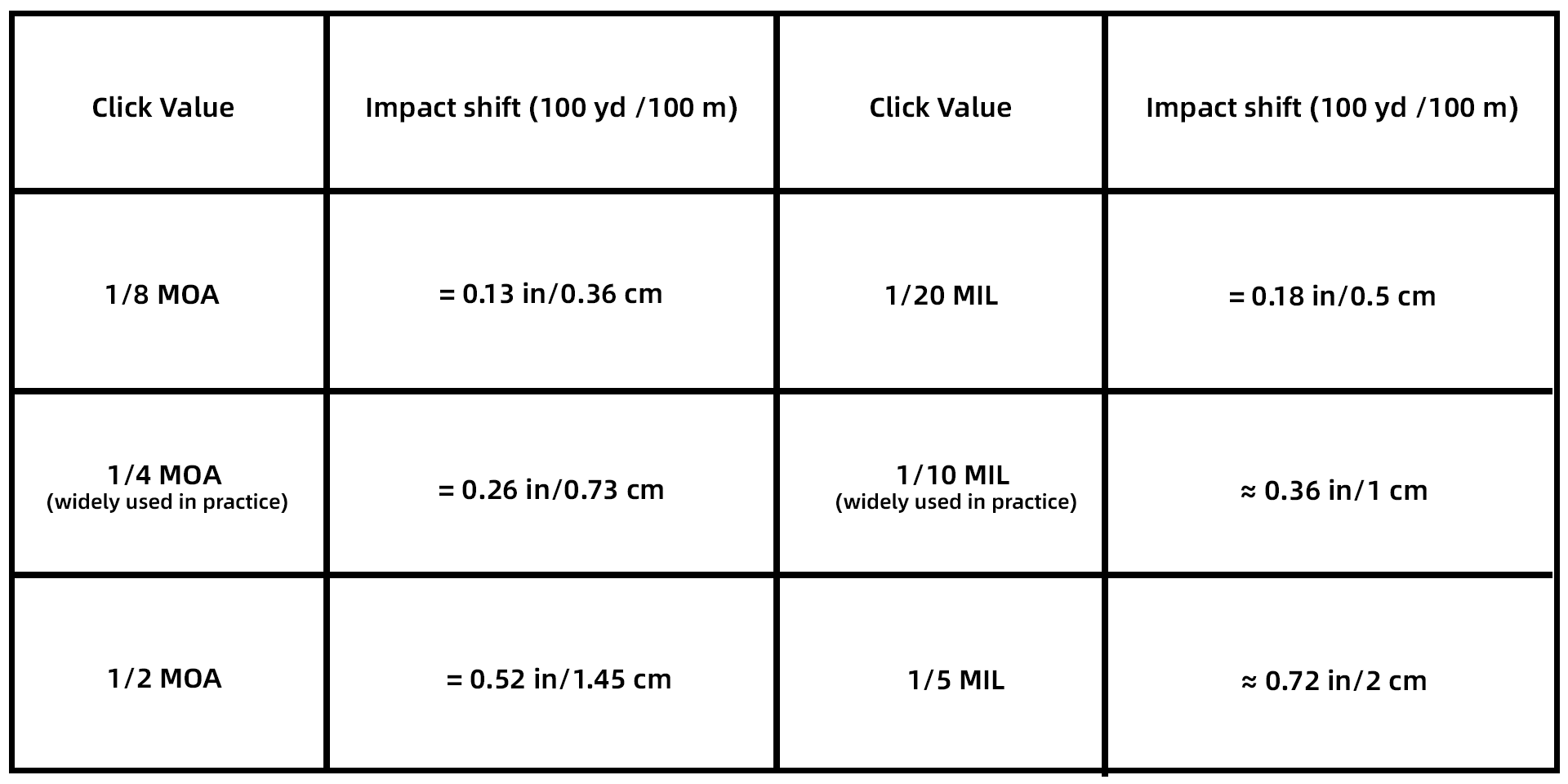
As shown in the table, the smaller the click value, the smaller the movement of the point of impact per adjustment, which allows shooters to perform finer elevation and windage corrections.
Some precision-oriented scopes adopt smaller click increments for this purpose. For example, the Tauron 5-50×60 ED SFP Rifle Scope (SCOL-69) and Continental x8 6-48×56 ED MIL Rifle Scope Benchrest (SCOL-TM52) use 0.05 MIL click values. This enables ultra-fine correction, which is particularly relevant in benchrest and extreme long-range shooting, where even minimal deviation can affect point of impact. This level of precision is especially important in F-Class and extreme long-range (ELR) shooting scenarios, where precise holdovers at 1,200 metres and beyond are critical.
2. What Is Adjustment Range on a Rifle Scope?
Adjustment range refers to the maximum amount of elevation or windage adjustment that a riflescope turret can provide, usually expressed in MOA or MIL. The rifle scope adjustment range determines how much correction is available when compensating for bullet drop and wind drift at different shooting distances.
Typical riflescope specifications include:
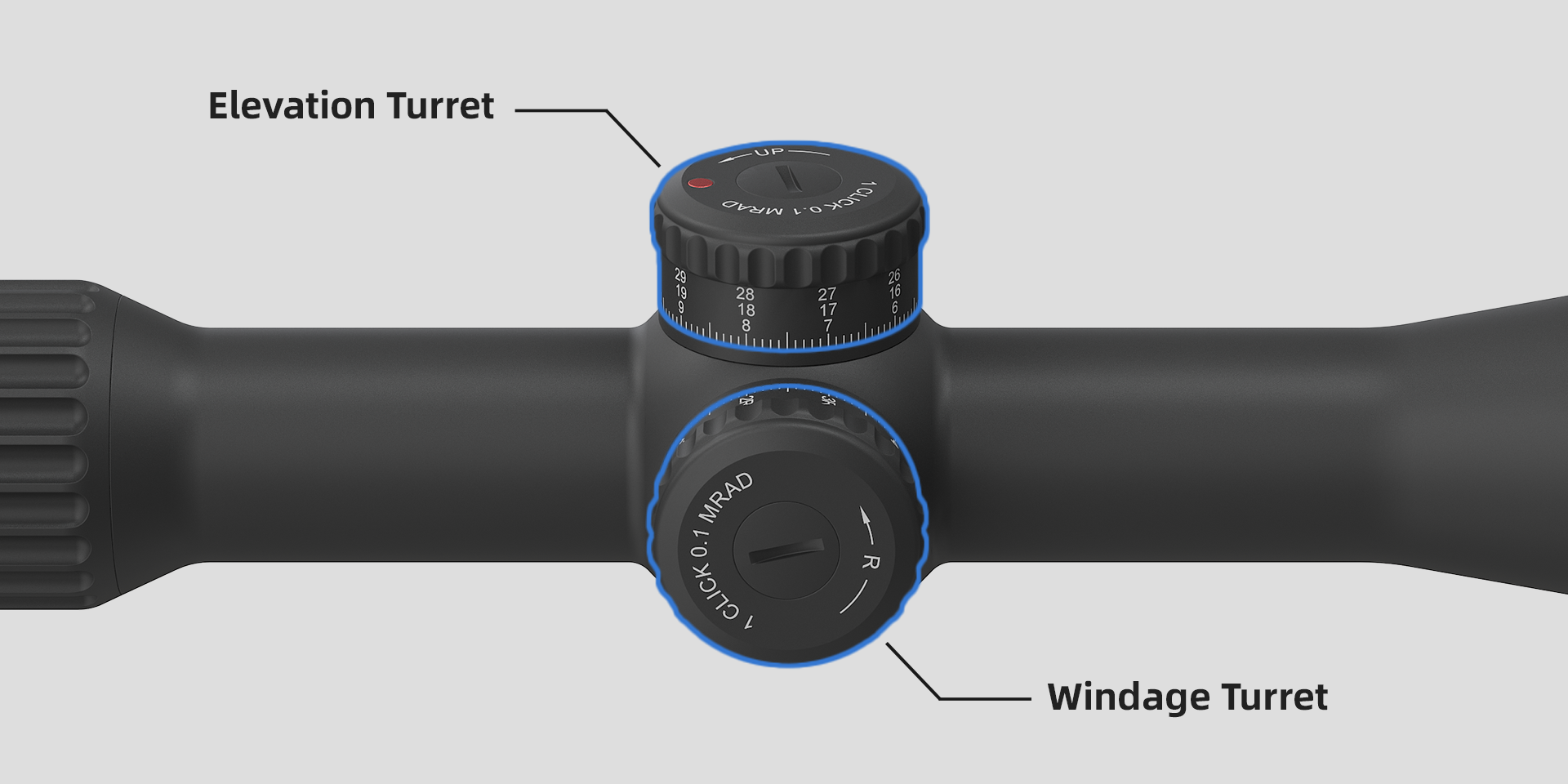
A larger rifle scope adjustment range allows shooters to dial for greater bullet drop compensation when shooting at longer distances. This is because bullet drop increases with distance, requiring greater elevation travel to maintain accurate point of impact. The same principle also applies in airgun shooting, where even at 100–200 metres, shooters still pay close attention to elevation adjustment due to pronounced trajectory curvature.
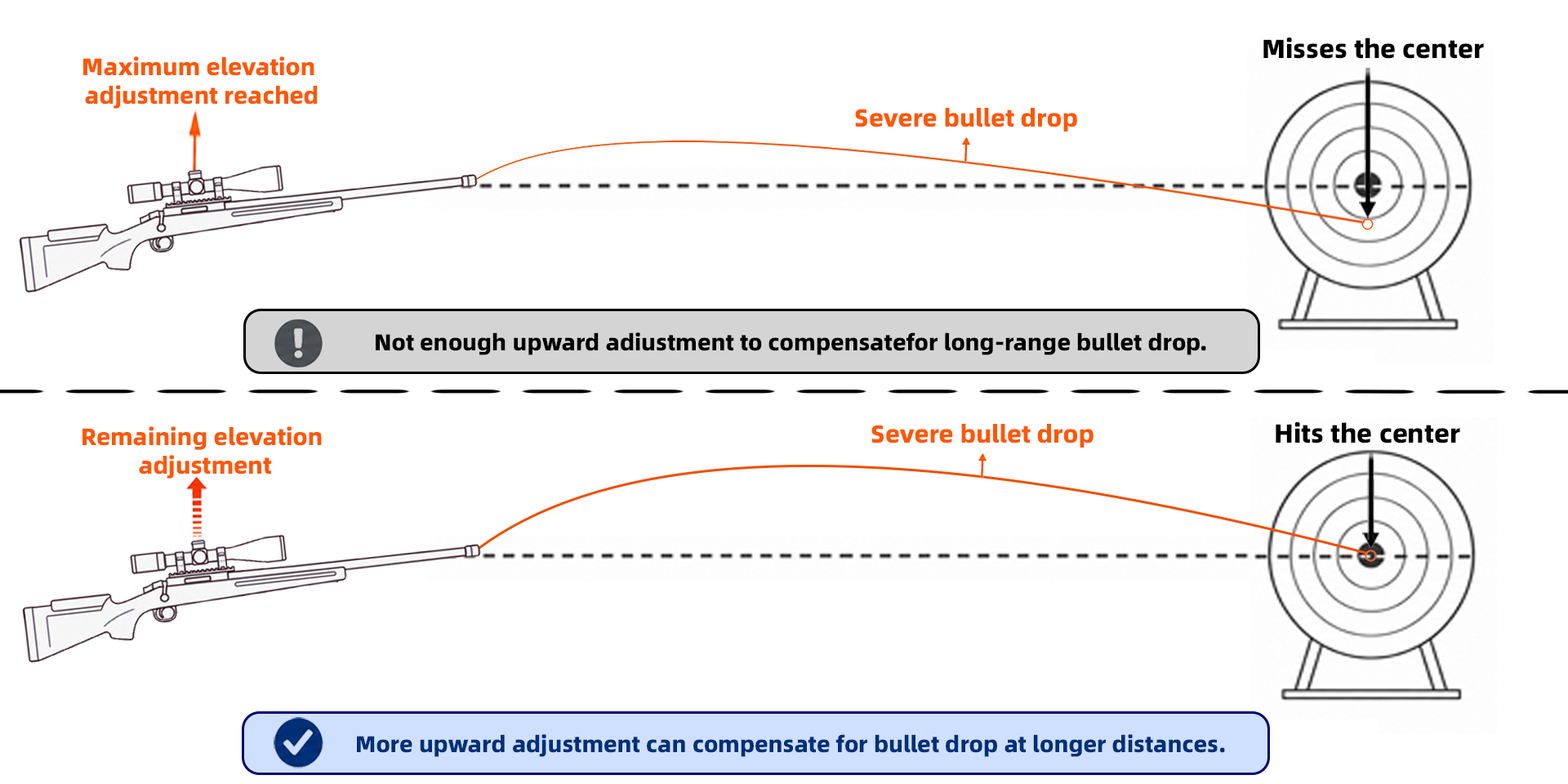
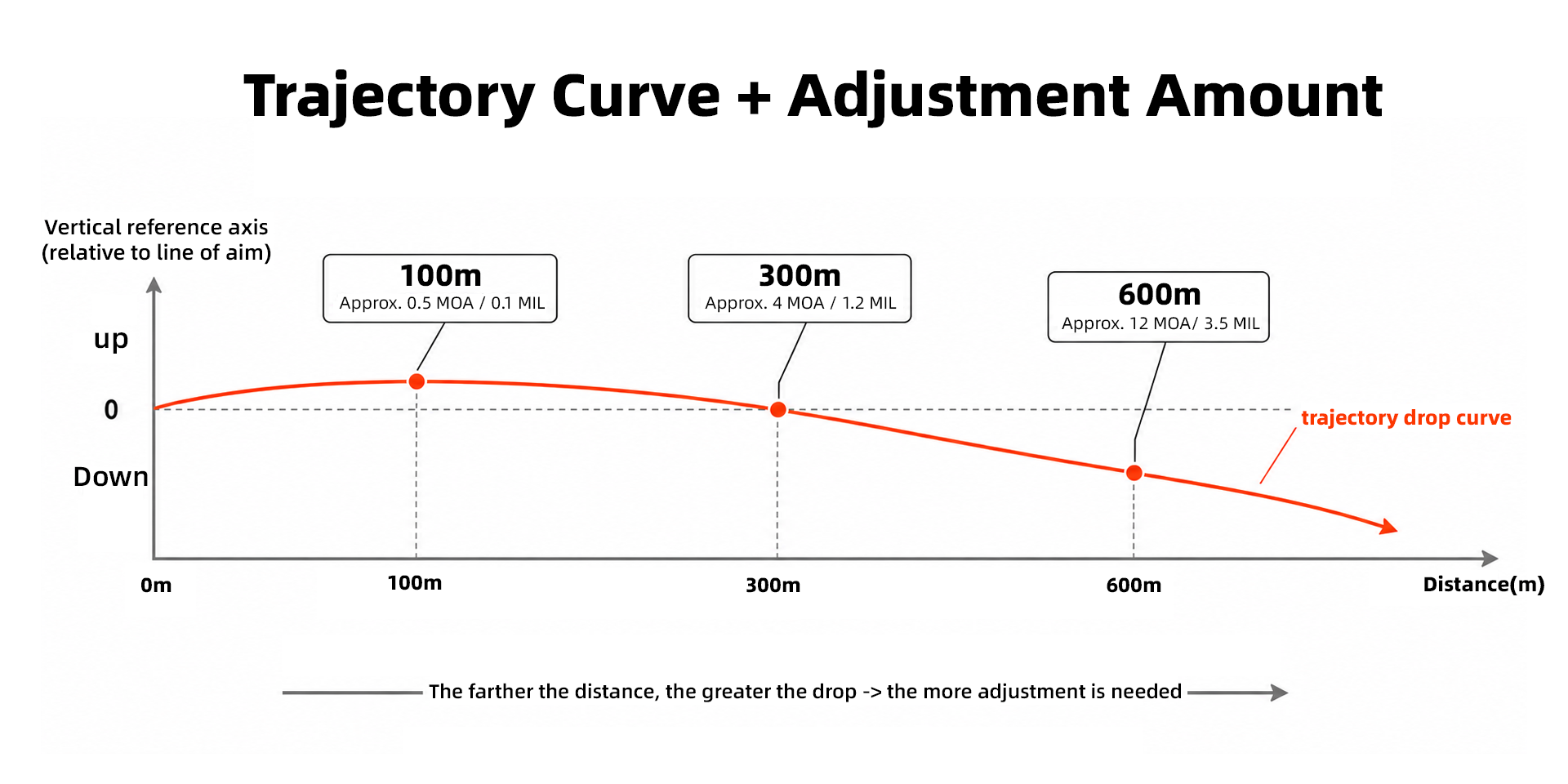
In long‑range shooting, bullets experience significant drop as distance increases. Shooters must compensate for this drop by adjusting the elevation turret on the rifle scope.
If the scope provides a large adjustment range, shooters can make precise elevation corrections at extended distances without reaching the turret’s adjustment limits.
However, in long-range shooting setups where internal adjustment is insufficient, shooters typically use angled scope bases, e.g., X-ACCU 30mm 1.2" Medium Profile 1- Piece 20MOA Picatinny (XASR-3011), to extend usable elevation travel.
For this reason, a sufficient rifle scope adjustment range is particularly important for long‑range and precision shooting applications.
3. How to Calculate Scope Turret Clicks?
When learning how to adjust a rifle scope for different distances, shooters must convert the observed error into turret clicks. For more detailed information, please refer to our guide on How to Adjust Your Rifle Scope?
The following examples illustrate how to perform precise scope adjustments using MOA and MIL systems.
3.1 Example: MOA Scope Adjustment
Formula:
Required Clicks = (Impact Shift ÷ MOA Value at Distance) ÷ Click Value
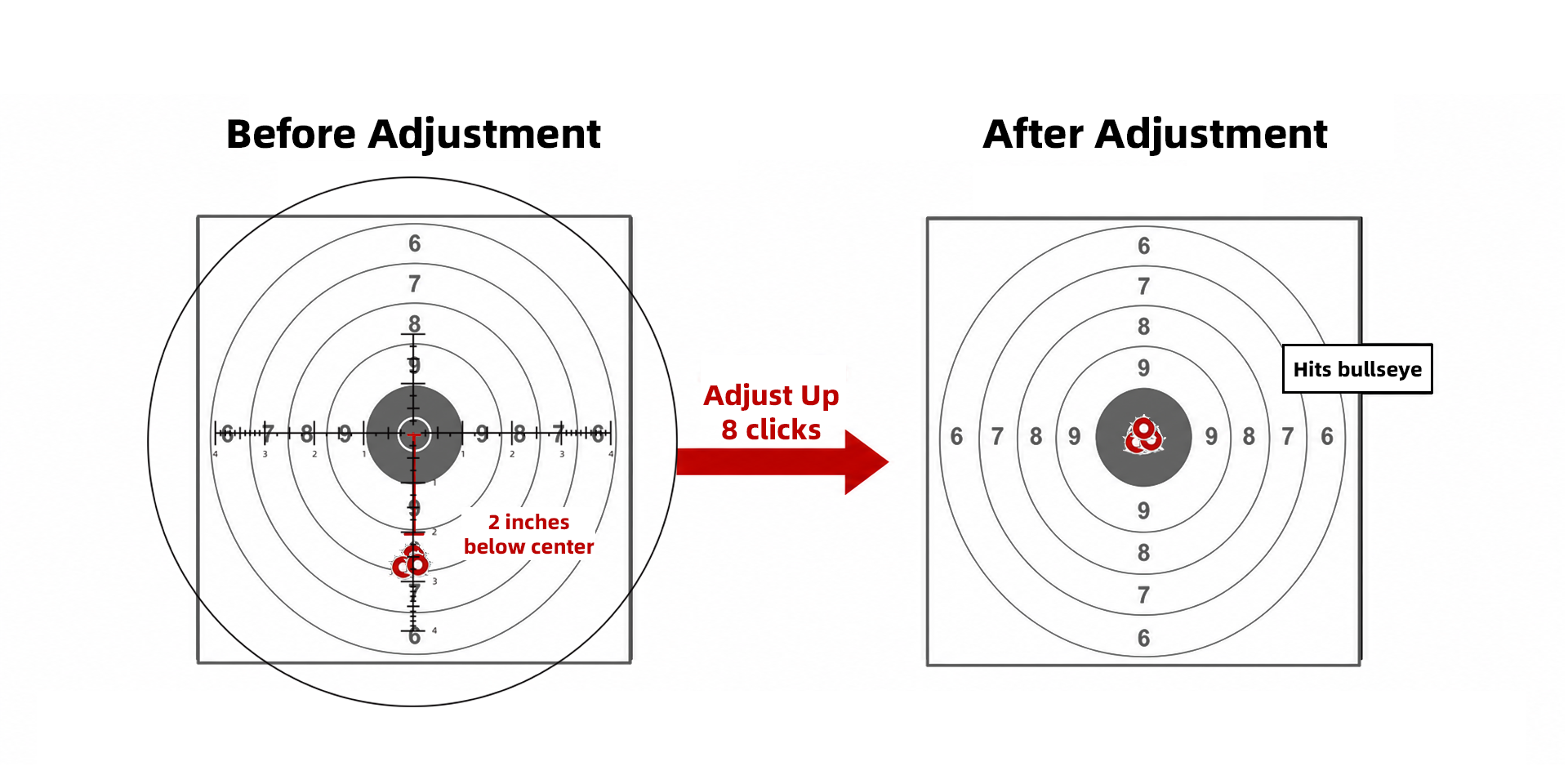
Scenario:
● Distance: 100 yards
● Shot impact: 2 inches low
● Scope click value: 1/4 MOA per click
Step 1 — Convert inches to MOA
At 100 yards, 1 MOA ≈ 1 inches.
To determine the required correction:
2 ÷ 1 ≈ 2 MOA
Step 2 — Convert MOA to turret clicks
Each click equals 0.25 MOA.
2 ÷ 0.25 ≈ 8 clicks
Result:
Dial 8 clicks up on the elevation turret to correct the point of impact.
This calculation method helps shooters understand how many clicks to adjust a rifle scope when using an MOA-based turret system.
3.2 Example: MIL Scope Adjustment
Formula:
Required Clicks = (Impact Shift ÷ MIL Value at Distance) ÷ Click Value
Scenario:
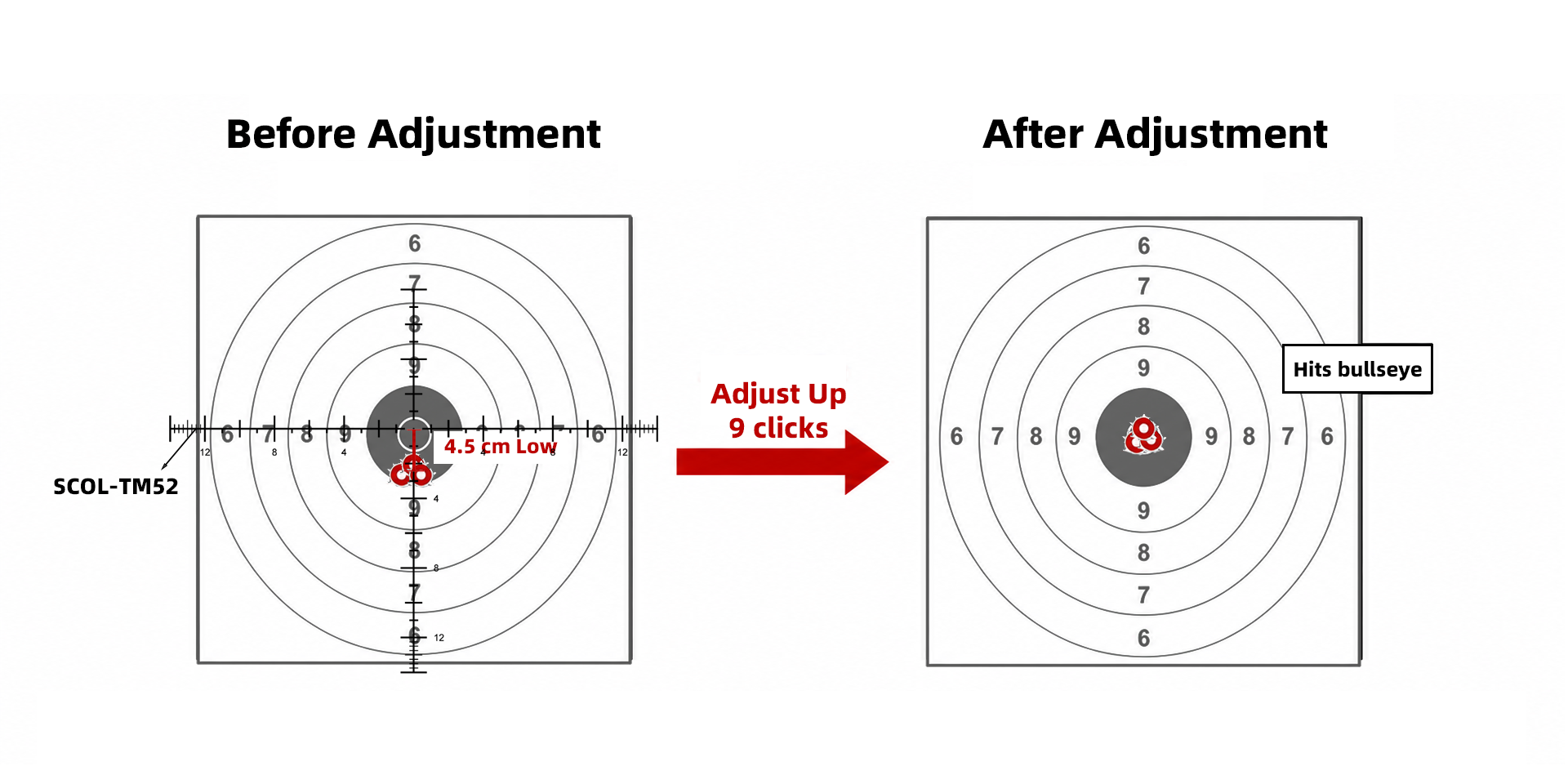
● Distance: 100 meters
● Impact: 4.5 cm low
● Click value: 0.1 MIL per click
Step 1 — Convert impact shift to MIL
At 100 meters, 1 MIL ≈ 10 cm
To determine the required correction:
4.5 ÷ 10 = 0.45 MIL
Step 2 — Convert MIL to turret clicks
Each click equals 0.1 MIL.
0.45 ÷ 0.1 = 4.5 clicks
Because turret adjustments are made in fixed click increments, the value must be rounded to the nearest whole click. In this case, the shooter would dial 4 or 5 clicks depending on the desired correction.
By comparison, Scopes with smaller click values, such as 0.05 MIL per click, allow finer adjustments and therefore provide greater correction precision.
For the same 0.45 MIL correction, a scope with 0.05 MIL click increments would require 9 clicks, illustrating that smaller click increments allow finer and more precise adjustments.
4. Conclusion
Understanding click value and adjustment range, allows shooters to accurately control their point of impact.
Whether using MOA or MIL scope adjustments, mastering these principles helps shooters perform reliable rifle scope zeroing, make precise corrections, and confidently dial elevation for longer distances.
With proper technique and a well-designed rifle scope, turret adjustments become a powerful tool for achieving consistent shooting accuracy.
FAQ
1. Do suppressors change point of impact?
Yes—adding a suppressor often shifts the point of impact, usually slightly, due to added weight and changes in barrel harmonics, but it’s typically consistent once mounted so you can re-zero for it.
2. Can you use an moa red dot to estimate range?
Yes—but only roughly. An MOA-based red dot can be used for basic range estimation if you know the target size, since MOA represents angular measurement, but without a calibrated reticle it’s not very precise compared to dedicated ranging systems.
3. How to set eye relief on a rifle scope?
To set eye relief on a rifle scope, mount the rifle in your normal shooting position, move the scope forward or backward until you see a full, clear image with no shadow at your typical head position, then secure the scope in place.