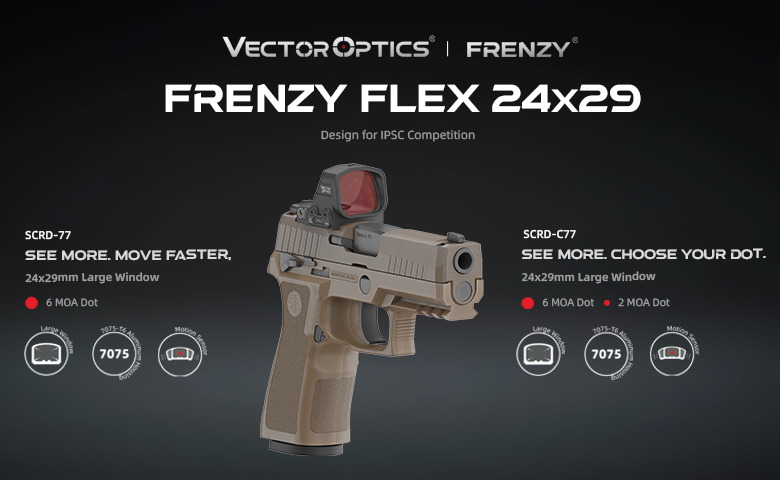
When selecting a red dot sight, the choice between spherical and aspherical lenses is critical to performance and application suitability. This article provides a detailed comparison to help you make an informed decision.
1. What Are Spherical and Aspherical Lenses in Red Dot Sights?
1.1 Spherical Lens Red Dot Sights
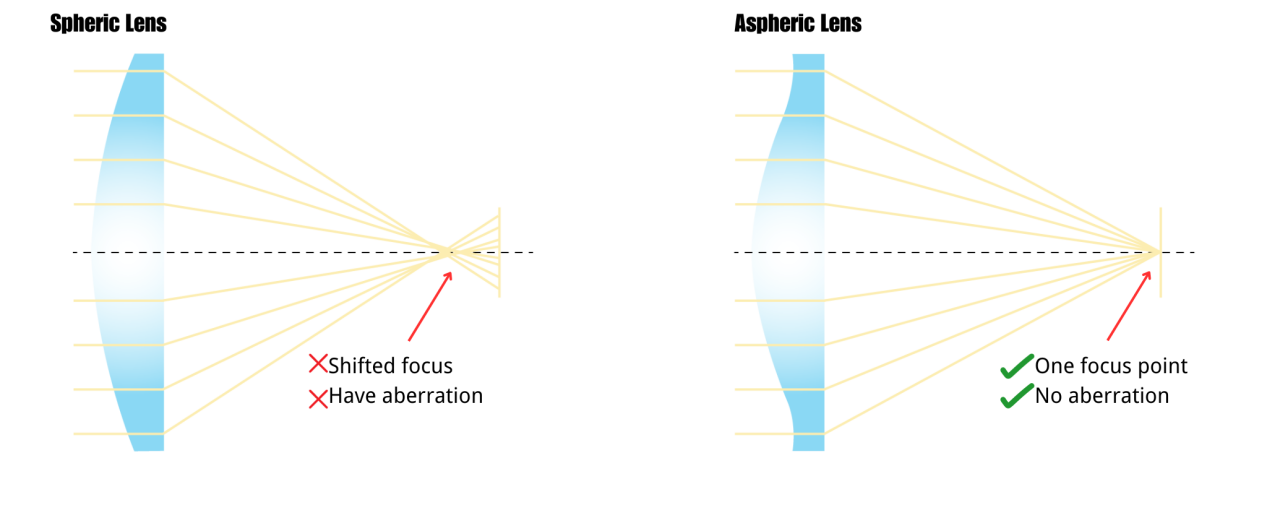
Spherical lenses are traditional optical components with a uniform curvature across their surfaces, typically shaped as a segment of a sphere. These lenses are manufactured through conventional grinding and polishing processes, with one or both surfaces being concave, convex, or flat.
1.2 Aspherical Lens Red Dot Sights
Aspherical lenses feature a non-uniform curvature, allowing for precise correction of optical aberrations. This advanced design enhances clarity and performance, particularly in high-precision applications.
2. What Are the Advantages of Spherical and Aspherical Lenses in Red Dot Sights?
2.1 Advantages of Spherical Lens Red Dot Sights
· Cost-Effective: Lower production costs make spherical lenses widely accessible.
· Proven Technology: Reliable for standard applications where advanced optical precision is not paramount.
2.2 Advantages of Aspherical Lens Red Dot Sights
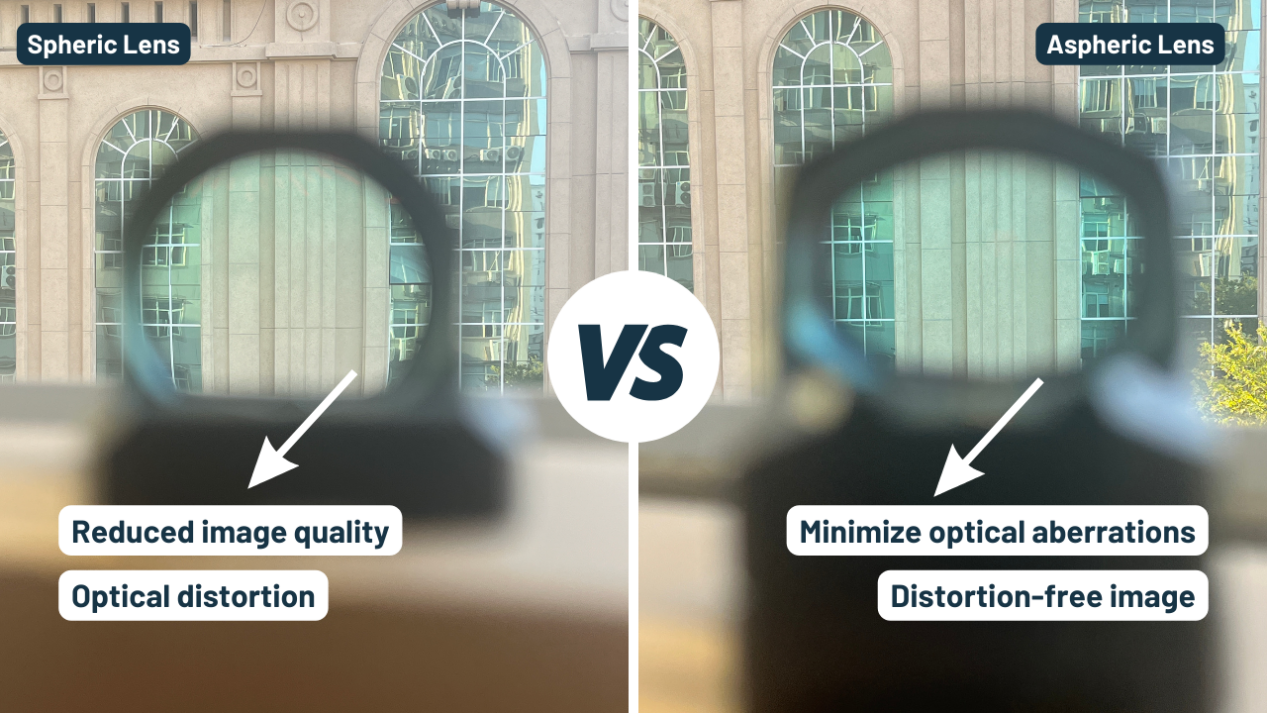
· Superior Optical Performance: Minimizes spherical aberration, coma, and astigmatism for sharper, distortion-free images.
· Lightweight and Compact: Achieves optimal performance with fewer lens elements, reducing weight and size.
· Enhanced Light Transmission: Maximizes light efficiency for brighter and clearer sight pictures.
· Reduced Parallax: Ideal for short focal lengths, improving accuracy in dynamic shooting scenarios.
3. What Are the Disadvantages of Spherical and Aspherical Lenses in Red Dot Sights?
3.1 Disadvantages of Spherical Lens Red Dot Sights
· Design Limitations: Prone to optical aberrations (e.g., spherical aberration, coma), which can degrade image quality and cause distortion.
· Bulkier Profile: Thicker lenses result in heavier and less compact sight designs.
3.2 Disadvantages of Aspherical Lens Red Dot Sights
· Higher Production Costs: Complex manufacturing processes increase expenses, reflecting in the final product price.
· Specialized Applications: Best suited for users prioritizing optical precision over budget constraints.
4. Conclusion
Aspherical lenses excel in optical performance, offering unparalleled clarity and precision for demanding applications. While they come at a premium, their advantages in weight, light transmission, and aberration correction justify the investment for professional users. Spherical lenses remain a practical choice for standard use, providing reliable performance at a lower cost.
FAQ
Q1. Do aspherical lenses make a noticeable difference when aiming in real use?
Yes, especially once you start switching between multiple targets or shooting in motion. The image tends to stay more stable across the field of view, with less edge distortion pulling your attention away from the reticle. Over longer sessions, this also helps reduce visual fatigue compared to simpler optical designs.
Q2. Why are spherical lenses still widely used in red dot sights today?
Because they strike a practical balance between performance and cost. For most general shooting scenarios, spherical lenses already provide acceptable clarity and brightness, making them a dependable choice for users who don’t need advanced optical correction or extreme precision.
Q3. Does the lens design influence the durability of a red dot sight?
In most cases, no. Durability is mainly determined by the structure of the housing, sealing quality, and shock resistance engineering. Both spherical and aspherical systems can be built into rugged optics, so the lens type is not the deciding factor for field reliability.
Q4. Why is the manufacturing process of aspherical lenses more expensive?
Aspherical surfaces require higher-precision forming and stricter quality control during production. Unlike uniform spherical curves, each surface must be carefully engineered to achieve specific optical corrections, which increases both production complexity and cost.